01 / 4–8 GHz references
What the 4–8 GHz label tells you
A frequency label identifies the interval written in a record; it does not, by itself, describe waveform, linearity, gain flatness, compression, duty cycle or output behavior at every point in that interval. The catalogue records here both state 4–8 GHz and 4 GHz bandwidth, so the page preserves that wording rather than converting it into a continuous measured-performance promise.
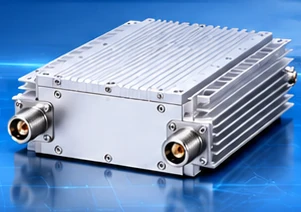
The records are component references. An RF power amplifier increases an RF signal’s amplitude, power output or drive capacity, while a power-amplifier module can integrate amplifier stages and surrounding circuitry in one package. That distinction matters when a module record is compared with a complete instrument, radio or certified system.
02 / 4–8 GHz references
The two documented records
Reference 16 is labelled 4–8 GHz, revision 2, 50 W, GaN, with SMA → SMA connectors and no listed features or circulator. Its weight is conflicting—770 g versus 439 g—and its dimensions are also conflicting—180 × 100 × 20 mm versus 134 × 80 × 22 mm—so both fields remain open for confirmation.
Reference 19 is labelled 4–8 GHz, 100 W, GaN, 1,193 g and 160 × 160 × 25 mm, with no listed features or circulator. Its connector entry conflicts between SMA → SMA and SMA → SMA/N. The 50 W and 100 W labels are useful catalogue distinctions, not a linear ranking or a guaranteed continuous-output result.
03 / 4–8 GHz references
How to read module and measurement evidence
A package label is only one part of an engineering record. Reviewers normally separate the frequency interval from the conditions and metrics that give it meaning, then reconcile revision, connector, mechanical and missing-field information against the applicable supplier documentation. This page therefore does not infer suitability from frequency or nominal power alone.
Measurement equipment is a different category. A vector network analyzer applies a known stimulus and reports device response such as S-parameters, while a spectrum analyzer measures signal power across frequency. Neither description turns these two catalogue records into calibrated bench instruments, test systems or proof of compliance.
04 / 4–8 GHz references
Civilian documentation path
For a civilian procurement or design review, ask for the applicable revision, complete electrical and mechanical datasheet, connector definition, stated test conditions, and clarification of every conflicting or missing field. A written comparison should retain the source label and identify what still requires confirmation instead of silently choosing the more favorable value.
Conformity assessment is a separate evidence layer. IEC describes conformity-assessment systems as approaches to testing, inspection and certification; an amplifier label alone is not an accredited-laboratory scope, a standards-specific report or a system certification. New Ark presents these records for documentation review and does not publish deployment, operating, interference or performance guidance.