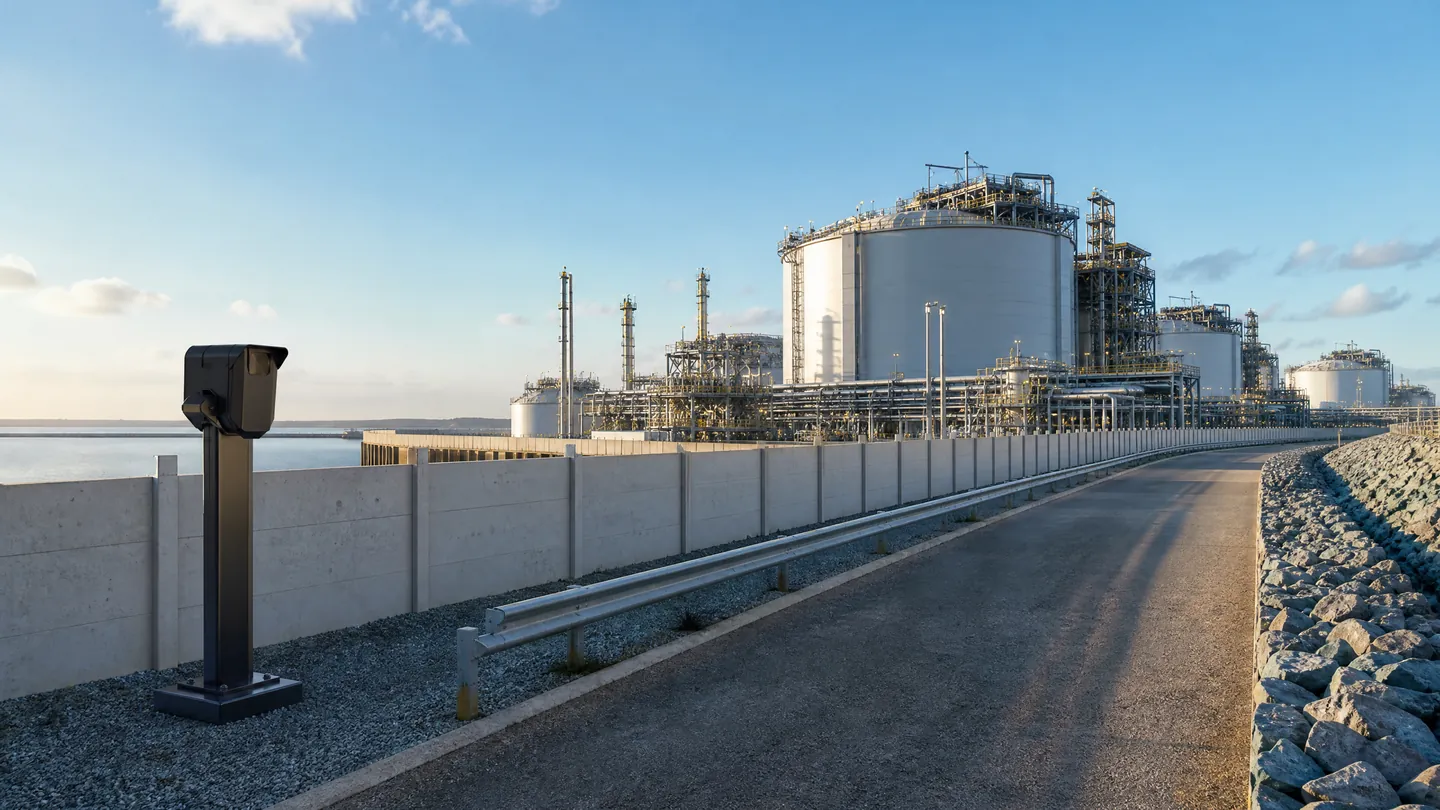
Hong Kong New Ark Intelligent Technology Limited (New Ark) focuses on acoustic UAV detection and low-altitude security solutions designed for oil & gas, chemical, energy, and other high-hazard facilities, with safe-offset deployment, passive information inputs, and artificial intelligence as project-planning foundations.
With acoustic sensing at the core, systems may connect multi-sensor fusion and C2 integration within a written project scope—forming a full-cycle path from detection, identification, and tracking context through authorised review and response governance. Final deployment, operation, and compliance arrangements require qualified accountable personnel.
A security perimeter starts before a threat arrives.
New Ark organizes low-altitude security from the outside in—using passive acoustic context, accountable human review, and local deployment pathways that can be discussed within project scope.
01
Why we begin here
High-hazard oil, gas, and chemical sites can face a practical paradox: the locations that need external low-altitude context may also be constrained by hazardous-area classification, site rules, or equipment conditions that make active transmitting equipment unsuitable inside a core hazardous zone. This can leave a compliant yet less-observable information gap around the perimeter outside the core zone. Passive acoustics does not actively transmit electromagnetic energy, so it can be considered as one information input in external safe-offset and perimeter assessment. New Ark's chief acoustic scientist brings 40+ years of industry experience and its engineering team averages 20+ years; those credentials support long-term engineering discussion, not a substitute for site conditions, compliance review, or written validation.
02
What changes for project teams
Move from after-the-fact investigation toward earlier perimeter context that accountable personnel can review. Within authorised project scope, passive acoustic arrays may be planned at external safe offsets, with acoustic context cross-checked against EO/IR, authorised RF reception, or other sources before entering a human-attended C2 workflow. Public references to a 500 m class for multi-rotor context, a 5 km class for fixed-wing context, and 16+ / 48+ concurrent-object references are for initial project discussion only; they are not commitments on siting distance, coverage, detection, identification, tracking, or outcome.
03
Mission
Make perimeter-first safety a standard starting point for low-altitude security planning at high-hazard facilities. New Ark's three-year direction is to work, in authorised and written-scope collaborations, toward supporting project discussion across 300 high-hazard industrial facilities, bringing earlier information context to 100,000 frontline operators and safety engineers, and developing 50 local partner engineering teams. Through PCBA and local-assembly pathways, partners may discuss deployment, maintenance, spares, and evolution within project scope; directional objectives are not public delivery or performance guarantees.
01
Passive information input
Does not depend on active electromagnetic transmission; final plans remain subject to site classification and local requirements.
02
Project-level references
500 m class / 5 km class and 16+ / 48+ are initial discussion references requiring site and written validation.
03
Accountable human review
Under authorised conditions, multiple information sources are cross-checked before a human-attended, accountable workflow.
This narrative and its figures are project-communication references only—not deployment instructions, system design, compliance conclusions, or performance commitments for any specific site.
CAPABILITY CHAIN / 02
Build continuous low-altitude security capability—from sensing context to authorised review.
AI acoustic sensing is the core. Acoustic context, visual confirmation, multi-sensor corroboration, and C2 event governance form one scalable capability chain.
01
AI Acoustic Sensing
AI 聲學感知
02
Multi-Sensor Fusion
多傳感器融合
03
Intelligent Identification
智能識別
04
Target Tracking
目標跟蹤
05
Low-Altitude Security
低空安全
TECHNOLOGY POSITIONING / 03
Acoustic intelligence at the core of fusion-based assessment for complex environments.
New Ark advances AI acoustic sensing alongside fibre-linked context, low-altitude target awareness, and multi-sensor coordination—structured as a verifiable system architecture within defined deployment boundaries, authority conditions, and project requirements.
01
Acoustic detection & AI
Acoustic features, directional context, and edge processing establish a continuous information input for complex low-altitude environments.
NEW ARK / TECH REFERENCE
02
Fibre-linked context & fusion
Within authorised scope, integration with radar, RF reception, EO/IR sensors, and command platforms supports cross corroboration and accountable review.
NEW ARK / TECH REFERENCE
03
Modular delivery & local assembly
Complete systems and core PCBA can be discussed as project delivery paths. Partners may plan local assembly, maintenance, and spare-parts coordination within written scope; interfaces, certification, and production conditions are confirmed case by case.
NEW ARK / TECH REFERENCE
ACOUSTIC TECHNICAL TEAM / PEOPLE & ENGINEERING
Deep acoustic technical grounding, backed by mature engineering-delivery capability.
ARC-PERIMETER acoustic detection is supported by a team with sustained work in industrial-acoustics research and engineering. From array design to field engineering, the team structures its work around reliability, reviewability, and site fit.
0140+ years
Chief acoustic scientist industry experience
0220+ years avg.
Acoustic R&D engineering team experience
03Array → field
Research, prototype & engineering collaboration
01
Chief acoustic scientist · 40+ years of industry experience
Brings more than four decades of research and engineering experience across spatial acoustics, sensor arrays, and signal processing, with a long-term focus on acoustic target detection and noise suppression in complex environments. New Ark team materials describe contributions to the architecture and algorithm iteration of multiple generations of industrial acoustic-detection systems, including microphone-array topology, adaptive background-noise processing, and acoustic-feature-library research.
02
Acoustic R&D engineering team · 20+ years average industry experience
The engineering team covers MEMS acoustic-array hardware, embedded algorithms, industrial-environment reliability design, and field-deployment calibration, with an average of more than 20 years of industry experience. The team collaborates from principle validation and prototype development through engineering delivery, and discusses project-specific fit for complex sound fields, terrain conditions, and compliant deployment at high-hazard industrial sites.
Team credentials are company information provided by New Ark. Product configuration, site fit, validation scope, and project outcomes remain subject to field conditions, engineering review, compliance requirements, and written project documents.
CRITICAL INFRASTRUCTURE / DEPLOYMENT CONTEXT
CRITICAL INFRASTRUCTURE / 04
Project-led technical support for critical-infrastructure low-altitude security.
Innovation-led development across the intelligent low-altitude security frontier.
We invest in acoustic sensing, artificial intelligence, edge computing, multi-sensor fusion, accountable human review, and system integration. Capability, suitability, and outcomes always remain subject to authorised site conditions, compliance requirements, and written validation.
NEW ARK / FUTURE DIRECTION
From isolated devices to a coordinated security foundation that can be validated, maintained, and evolved locally.
New Ark advances low-altitude security from standalone devices toward intelligent sensing, coordinated detection, fusion-based assessment, and C2 governance. Through global collaboration and a local-assembly path that can be discussed within project scope, we aim to help partners retain visibility and agency over deployment, maintenance, spares, and long-term evolution.