01 / 2–8 GHz requirements
What the 2–8 GHz request means
A request for 2–8 GHz describes a continuous frequency interval from 2 GHz through 8 GHz. It is not the same as a nominal centre frequency, a single instantaneous bandwidth figure, or several separate sub-bands. A complete match would need documentation that addresses the whole requested interval and identifies what the record actually represents: a device, an amplifier module, or a larger instrument.
The present catalogue does not provide that complete record. The 2–8 GHz scope should therefore remain a requested feasibility range. Frequency labels alone do not establish gain, linearity, output behaviour, thermal limits, interfaces, or suitability for a particular civilian system, so those points must not be inferred from the interval itself.
02 / 2–8 GHz requirements
The closest documented comparison records
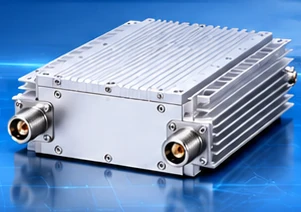
Reference 20 is recorded as 2–7.2 GHz, 5.2 GHz bandwidth, 50 W, GaN, and 160 × 160 × 25 mm. Its connector field conflicts between SMA → SMA and SMA → N, and its weight is not provided. Reference 21 is also recorded as 2–7.2 GHz and 5.2 GHz bandwidth, with 100 W, SMA → SMA, 2,569 g, GaN, and 240 × 220 × 25 mm.
These are comparison records with useful overlap from 2 GHz to 7.2 GHz, not 2–8 GHz product matches. Neither record documents the 7.2–8 GHz portion. Reference 20 also requires record reconciliation before its connector or any missing mechanical information is treated as settled; reference 21 should still be checked against the current supplier documentation for revision and scope.
03 / 2–8 GHz requirements
Why device and module evidence are different
RF power documentation distinguishes a semiconductor device from the completed amplifier around it. NXP’s RF design guidance explains that large-signal input and output impedance data are tied to test conditions and amplifier network design; small-signal parameters should not be treated as a finished power-amplifier specification. A device technology label such as GaN is therefore not evidence of a complete 2–8 GHz module.
For a civilian documentation review, the useful questions are documentary: which revision is being quoted, what frequency interval is explicitly stated, which power field is a label rather than a guaranteed operating result, and which interface or mechanical fields remain unknown? That review can compare a module record with upstream device literature without claiming an application match or promising engineered-to-order availability.
04 / 2–8 GHz requirements
A written civilian feasibility review
A responsible review should request the exact band definition, module-versus-instrument identity, revision-controlled datasheet, interface description, mechanical drawing, and any stated measurement conditions. Civilian test-and-measurement documentation can then be considered on its own terms: Keysight describes amplifier gain characterization as a repeatable measurement involving known input and measured output across frequency, rather than as a conclusion drawn from a band label.
Accreditation language also needs care. ILAC explains that an accreditation scope describes the services for which a conformity-assessment body has demonstrated competence, while IEC distinguishes a test report from independent product certification. A catalogue entry is not an accredited-laboratory scope or a certification record. New Ark can keep the 2–8 GHz request open for document review, but no supplied module, availability, certification, performance, or suitability conclusion is established here.