
Reference model 04
Recorded fields- Frequency referenceRecorded
- 100–1000 MHz
- Bandwidth referenceRecorded
- Bandwidth1 GHz
- Power referenceRecorded
- 100 W
- Transistor technologyRecorded
- LDMOS (new revision)
RF MODULES / PRODUCT INFORMATION
This New Ark reference group covers catalogue records labelled 100–1000 MHz. The interval crosses VHF and UHF; it should be read as a documented frequency span, not as proof of a certified system, stocked product, or application match.
01 / 100 MHz–1 GHz references
100 MHz–1 GHz is a continuous interval in the reference label, but it is not wholly UHF. It begins in VHF and reaches the 1 GHz endpoint, so a review should preserve the endpoints and the unit conversion rather than replacing the span with a broad band nickname. Civilian RF device families can also be divided into narrower VHF and UHF examples; a frequency label alone does not establish the same design, signal conditions, or finished product.
The catalogue distinction matters where a project asks for coverage across the whole interval. A record that lists 100–1000 MHz is different from a record with separated bands, a narrower instantaneous bandwidth, or a requested band that has not been documented. New Ark therefore treats the range as a comparison starting point. It does not infer suitability for communications, sensing, EMC, or any C-UAS function from frequency alone.
02 / 100 MHz–1 GHz references
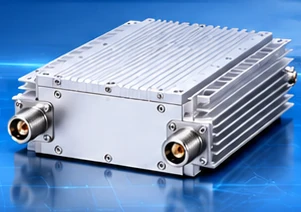
Reference 04 lists 100–1000 MHz, 1 GHz bandwidth, 100 W, SMA to N connectors, 1020 g, LDMOS (new revision), no listed features, no listed circulator, and dimensions of 175.5 × 100 × 24 mm. These are preserved catalogue fields, not independent measurements or a statement that every operating condition is supported. The phrase “new revision” is retained as a record label and is not treated as proof of a new semiconductor class.
Reference 08 lists 100–1000 MHz and separately 1–3 GHz as Revision 2, with 30 W, SMA to SMA connectors, 396 g, GaN, no listed features, no listed circulator, and dimensions of 162.65 × 52.5 × 20 mm. Its bandwidth notation is unclear and requires confirmation. The 1–3 GHz entry is not merged with 100–1000 MHz into one continuous 100 MHz–3 GHz module, and unsupported power or performance values are not filled in.
03 / 100 MHz–1 GHz references
An RF power amplifier may be a device, an integrated module, or part of a larger amplifier system. Supplier documentation normally needs to identify which level is being described, because a transistor or module record does not by itself establish enclosure integration, protection, calibration, compliance, or system-level behaviour. The reference group is consequently a documented product-navigation aid, not a declaration of a complete instrument or certified assembly.
For civilian engineering review, useful evidence includes a controlled datasheet or revision record, defined frequency and bandwidth notation, mechanical and connector information, and test documentation that states what was measured. Keysight’s high-power measurement guidance illustrates why characterization records must account for instrument limits and traceable measurement context. An accredited laboratory’s scope is also specific: ILAC explains that accreditation bodies and laboratories are recognized for defined testing or calibration scopes, so a generic certification claim cannot be inferred here.
04 / 100 MHz–1 GHz references
Use the two records to structure a written review: confirm whether the requested interval is truly continuous, ask which revision governs, reconcile the unclear notation on Reference 08, and verify whether the item is a module or only a component-level record. Connector, mass, dimensions, and technology labels help identify the record, but they do not predict thermal, linearity, waveform, durability, or field performance.
Any band, power class, or application beyond the documented fields remains a requested feasibility scope rather than a supplied module. New Ark can keep the discussion civilian and documentation-led, while leaving system architecture, lawful spectrum use, safety controls, and any final suitability decision to the responsible integrator and applicable authorities. No model is matched to a C-UAS role by frequency or nominal power.
SOURCE RECORDS / COMPARISON ONLY
The cards below reproduce the specifically linked supplier reference records. They are not a list of suitable or available products. Reference numbers are not confirmed commercial model codes; every field and applicable revision requires written confirmation.
Units and source notation are retained where stated. An uncertain or missing unit is not inferred.
DOCUMENTATION / READING CONTEXT
Rohde & Schwarz — civilian RF amplifier and test-system explanations
NXP — official VHF/UHF LDMOS device context
Keysight — application note on characterization and measurement limits
International Laboratory Accreditation Cooperation — defined accreditation scopes
Sources support the topic discussion; they do not independently validate the supplied module records or establish project suitability.
PRODUCT TOPIC / COMMON QUESTIONS
No. The interval crosses VHF and UHF and reaches the 1 GHz endpoint. The catalogue label should be preserved as written rather than renamed as a single-band UHF product.
Only Reference 04 and Reference 08 are included. Reference 04 lists 100–1000 MHz; Reference 08 lists 100–1000 MHz and separately 1–3 GHz Revision 2.
No. Its 100–1000 MHz and 1–3 GHz entries remain separate, and its bandwidth notation requires confirmation. The records do not prove one uninterrupted module or complete performance across 100 MHz–3 GHz.
No. They are reference fields, not independent test results, stock statements, certification, or application matching. Suitability requires written technical evidence and any relevant, scope-specific assessment.
Continue exploring
Return to the parent category or read another topic in the same group.
RF MODULES / PRODUCT INFORMATION
Open the RF catalogue, download the English Excel workbook or view all 22 independent reference records. Recorded values and revision differences still require confirmation.
07 / CONSULTATION
Choose a contact based on what you need to discuss. All three links open WhatsApp directly—no registration or enquiry form required.
Product-family enquiries, quotations and commercial discussions.
+86 19928199130Message salesModule questions, product documentation and technical clarification.
+86 18123677761Message technical supportA project-specific discussion about mechanical fit, interfaces and support scope.
+85295658748Message the project team