
01 / WhatsApp
Sales enquiries
Product-family enquiries, quotations and commercial discussions.
+86 19928199130Message salesRF MODULES / PRODUCT INFORMATION
An RF power amplifier module can be one part of a civilian radio or wireless communications design. It is not, by itself, a complete radio, a certified communications product, or proof that a particular system application is supported.
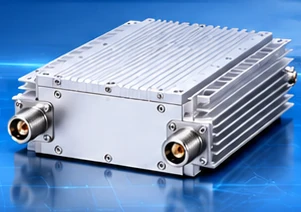
01 / Communications RF modules
In a communications chain, the power amplifier raises the RF signal to the level required by the surrounding design. The module may include an amplifier stage and defined RF interfaces, but the radio, antenna path, control electronics, enclosure, power architecture, and regulatory responsibilities remain system-level matters. A catalogue label therefore describes a component record rather than a complete civilian communications product.
The exact signal matters as much as the nominal frequency. NXP’s technical explanation of cellphone amplifiers connects PA requirements with modulation format, output power, linearity, supply conditions, and the system’s applicable requirements. That is why a frequency or power value alone cannot establish suitability for a handset, private radio, public-network device, or any other communications design.
02 / Communications RF modules
Civilian communications signals can place different demands on linearity and spectral behavior than an unmodulated reference. A responsible document set should identify the intended signal family, relevant performance definitions, interface assumptions, environmental limits, and the revision of the underlying record. Where those details are absent, they should remain open questions rather than being filled in from a band or wattage label.
Keysight’s civilian test documentation describes calibrated vector signal generation and analysis for modulated power-amplifier measurements, including metrics such as adjacent-channel power ratio and error vector magnitude. This supports a documentation principle, not a test recipe: any claimed communications performance needs signal-specific evidence from the responsible product and system parties.
03 / Communications RF modules
The existing catalogue is preserved as a set of reference records. This page does not convert any record into a communications-certified match, and it does not infer an application from frequency, bandwidth, connector, technology, dimensions, or a nominal power field. Those fields can support an initial comparison, but they do not replace a current datasheet, interface definition, signal-specific evidence, or system-owner review.
The communication-rf-amplifiers topic has no approved matching-model references in the topic plan. Accordingly, unsupported bands and use cases should be treated as requested feasibility scope, not as supplied modules. Where the baseline records show missing, unclear, conflicting, or revision-dependent values, the uncertainty stays visible and must be resolved against the responsible technical documentation before selection.
04 / Communications RF modules
A module description should be kept separate from claims about a complete radio’s authorization or conformity. IEC defines conformity assessment as determining whether a product, system, or service meets requirements in a standard or specification, generally through testing or inspection. That assessment is tied to a defined object and scope; it is not created by placing a compliance word beside an amplifier listing.
For independent evidence, ILAC explains that accredited conformity-assessment bodies are recognized for specific calibrations, tests, inspections, or related services within stated scopes. Civilian procurement can therefore ask for the applicable record revision, signal and interface documentation, and any relevant third-party report or accreditation scope without assuming availability, certification, delivery timing, or application performance.
SCOPE / NO ASSIGNED MODEL RECORDS
No model shortlist is assigned to this application topic. An application context does not establish that any reference is suitable for the equipment.
DOCUMENTATION / READING CONTEXT
NXP technical paper
Keysight Technologies application documentation
International Electrotechnical Commission (IEC)
International Laboratory Accreditation Cooperation (ILAC)
Sources support the topic discussion; they do not independently validate the supplied module records or establish project suitability.
PRODUCT TOPIC / COMMON QUESTIONS
No. It is a component in a larger design. A complete radio also involves system interfaces, control, antenna-path integration, regulatory assessment, and product-specific documentation.
No. Those values do not establish modulation behavior, linearity, interfaces, environmental limits, certification scope, or application suitability. The exact signal and current technical record must be reviewed.
No approved matching-model references are assigned to this topic. Existing records remain reference material, while any requested band or use case without documented support is a feasibility question rather than a supplied match.
Request the current record revision, complete interface and environmental information, signal-specific evidence where relevant, and any applicable conformity or accredited-test scope. Do not treat a catalogue label as that evidence.
Continue exploring
Return to the parent category or read another topic in the same group.
RF MODULES / PRODUCT INFORMATION
Open the RF catalogue, download the English Excel workbook or view all 22 independent reference records. Recorded values and revision differences still require confirmation.
07 / CONSULTATION
Choose a contact based on what you need to discuss. All three links open WhatsApp directly—no registration or enquiry form required.
Product-family enquiries, quotations and commercial discussions.
+86 19928199130Message salesModule questions, product documentation and technical clarification.
+86 18123677761Message technical supportA project-specific discussion about mechanical fit, interfaces and support scope.
+85295658748Message the project team