01 / LDMOS RF amplifiers
What LDMOS means in an RF power path
LDMOS means laterally diffused metal-oxide semiconductor. In an RF power transistor, the silicon device is the active semiconductor element; it is not automatically a finished amplifier, calibrated instrument or complete communications product. A module adds its own mechanical packaging, matching, protection, thermal and interface decisions, so those details require module-level documentation rather than a technology name alone.
LDMOS is commonly documented for civilian radio infrastructure, broadcast and industrial RF equipment. Its practical meaning depends on the exact device, circuit, band, signal conditions and enclosure evidence. A supplier’s LDMOS label therefore helps describe the device technology, but it does not by itself establish efficiency, linearity, ruggedness, compliance or suitability for a particular system.
02 / LDMOS RF amplifiers
The two documented catalogue references
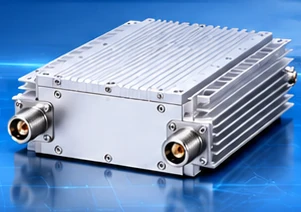
Reference 02 is recorded as LDMOS with separate frequency labels of 1.2 GHz, 1.5 GHz and 2.4 GHz. Its catalogue fields list lower-band bandwidth of 200 MHz, with 700–900 MHz as an example, and upper-band bandwidth of 300 MHz, with 2–2.3 GHz as an example; the listed power is 50 W. The same record shows SMA → N, 556 g, a listed circulator and dimensions of 179.6 × 66.91 × 22 mm.
Reference 04 is recorded as LDMOS (new revision), not as a separately verified semiconductor class. Its fields list 100–1000 MHz, 1 GHz bandwidth and 100 W, with SMA → N, 1020 g, no circulator listed and dimensions of 175.5 × 100 × 24 mm. These are catalogue reference labels, not measured operating guarantees, stock statements or proof that either record is a complete certified module.
03 / LDMOS RF amplifiers
How to read the catalogue responsibly
Frequency labels should be read exactly as documented. The multiple labels in reference 02 do not prove one continuous 1.2–2.4 GHz module, and the 100–1000 MHz label in reference 04 does not prove performance across every condition in that interval. Bandwidth examples are also not a substitute for a complete data sheet with signal, thermal, interface and verification context.
The new-revision wording in reference 04 identifies a catalogue revision label only. It should not be expanded into a claim of a new process, improved efficiency or improved reliability. Before a civilian procurement decision, request the applicable revision-controlled documentation and confirm which fields describe an assembled module, which describe a component, and which remain to be confirmed.
04 / LDMOS RF amplifiers
Civilian documentation and review scope
A useful review package can identify the exact record, technology, frequency notation, nominal catalogue power, connectors, dimensions, weight and any listed circulator. It can then separate those facts from information that is absent, such as a complete compliance file, application-specific performance evidence or a formal module data sheet. That separation makes comparisons clearer without turning a component record into a product promise.
New Ark’s LDMOS page is intended for civilian component and product-documentation review. Unsupported bands are not presented as supplied LDMOS modules, and no model is matched to a use case merely because its frequency or nominal power appears nearby. Where the required band or evidence is not documented, treat it as a request for written feasibility review rather than an offered product or guaranteed result.