
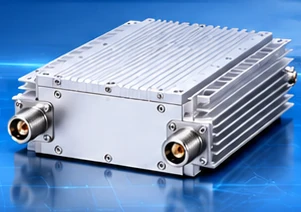
Reference model 01
Recorded fields- Frequency referenceRecorded
- 5–6 GHz
- Bandwidth referenceRecorded
- 1 GHz
- Power referenceRecorded
- 10-30 W
- Transistor technologyRecorded
- GaN
RF MODULES / PRODUCT INFORMATION
Gallium nitride (GaN) is a semiconductor technology used in RF power devices. A GaN device, a reference circuit, and a finished amplifier module are different evidence levels; this page keeps those distinctions visible for civilian component documentation.
01 / GaN RF amplifiers
GaN describes the transistor technology, not a complete product by itself. NXP’s device explanation shows how a GaN-on-SiC RF power transistor may be documented with a package, frequency span, power description, and thermal information. Those details describe the upstream device or a named reference design; they do not automatically establish the enclosure, connectors, protection functions, mechanical drawing, or revision of a finished module.
For a civilian integration review, ask which evidence is actually being offered: a discrete transistor, an evaluation or reference circuit, or a housed module. The catalogue records below are reference records supplied for comparison. A GaN label should not be read as a universal efficiency, reliability, waveform, or application-suitability guarantee, and frequency or nominal power alone is not a basis for matching a model to a system.
02 / GaN RF amplifiers
A useful module review starts with the complete record: stated frequency, bandwidth notation, nominal power label, RF connector path, dimensions, weight, technology, and any listed function. For example, reference 01 records 5–6 GHz, 1 GHz bandwidth, 10–30 W, SMA → SMA, 273 g, and 132 × 53 × 18 mm. Reference 10 records 100 MHz–2.4 GHz, 300–400 MHz bandwidth, 50 W, SMA → N, thermal control and VSWR function, 425 g, and 155 × 58 × 22 mm.
The remaining permitted records show why revision control matters. Reference 03 has no weight supplied; 09 has no features supplied; 12 has no features or weight supplied; 15 notes that its power claim requires validation; and 16 has conflicting weight and dimension records. References 06, 07, 11, 13, 18, 19, 20, and 22 also retain conflicts or unclear notation. These entries should remain confirmation items rather than being silently normalised into specifications.
03 / GaN RF amplifiers
The GaN reference catalogue includes 03 (3–6 GHz variants, 50 W), 05 (1–3 GHz variants, 100 W), 08 (100–1000 MHz and 1–3 GHz, revision 2), 09 (3–6 GHz, 30–40 W), 12 (300 MHz–2 GHz, revision 2), 14 (1–2 GHz, 80 W), 17 (1–3 GHz, 50 W), and 21 (2–7.2 GHz, 100 W). Their connector, enclosure, weight, bandwidth, and review status must be read from the individual record, not inferred from the technology label.
Additional records are 06 (conflicting frequency and bandwidth), 07 (conflicting frequency and bandwidth), 11 (conflicting frequency, bandwidth, and power), 13 (frequency notation and power require confirmation), 15 (1–6 GHz / 1–6.2 GHz, revision 2, validation note), 16 (4–8 GHz, revision 2), 18 (conflicting frequency and unclear variant rating), 19 (4–8 GHz with connector conflict), 20 (2–7.2 GHz with connector conflict), and 22 (unclear frequency plus conflicts). The catalogue does not prove a continuous 2–8 GHz or 6–18 GHz module. Those are requested feasibility scopes, not supplied modules.
04 / GaN RF amplifiers
A module page is not a calibrated bench-instrument certificate. Keysight explains that trustworthy RF power measurement depends on calibrated equipment and traceable reference sources, while IEC describes conformity assessment as verification that a product or system fulfils stated requirements. For a civilian lab, equipment compatibility and measurement evidence therefore belong in the project file alongside the amplifier record.
Accreditation is scope-specific. ILAC guidance explains that an accreditation scope describes the services for which a conformity-assessment body has demonstrated competence. An accredited laboratory scope does not, by itself, certify every GaN module or turn a catalogue label into a product approval. Request the exact revision, datasheet, mechanical and interface documents, declared limits, and any relevant third-party report before making a procurement or integration decision.
SOURCE RECORDS / COMPARISON ONLY
The cards below reproduce the specifically linked supplier reference records. They are not a list of suitable or available products. Reference numbers are not confirmed commercial model codes; every field and applicable revision requires written confirmation.
Units and source notation are retained where stated. An uncertain or missing unit is not inferred.
DOCUMENTATION / READING CONTEXT
NXP Semiconductors
Keysight Technologies
International Electrotechnical Commission (IEC)
International Laboratory Accreditation Cooperation (ILAC)
Sources support the topic discussion; they do not independently validate the supplied module records or establish project suitability.
PRODUCT TOPIC / COMMON QUESTIONS
No. GaN identifies semiconductor technology. A transistor, reference circuit, and housed module require different documentation, so the supplied catalogue records should be checked at the complete-record level.
No. A listed interval or variant is not proof of continuous verified performance, instantaneous bandwidth, or application suitability. Conflicting and unclear entries remain marked for confirmation.
It is a requested feasibility scope, not a supplied catalogue match. References 20 and 21 are labelled 2–7.2 GHz, while other records cover narrower ranges.
No. Accreditation and conformity assessment depend on the named service, method, requirements, and scope. The exact module revision and applicable report must be checked separately.
Continue exploring
Return to the parent category or read another topic in the same group.
RF MODULES / PRODUCT INFORMATION
Open the RF catalogue, download the English Excel workbook or view all 22 independent reference records. Recorded values and revision differences still require confirmation.
07 / CONSULTATION
Choose a contact based on what you need to discuss. All three links open WhatsApp directly—no registration or enquiry form required.
Product-family enquiries, quotations and commercial discussions.
+86 19928199130Message salesModule questions, product documentation and technical clarification.
+86 18123677761Message technical supportA project-specific discussion about mechanical fit, interfaces and support scope.
+85295658748Message the project team