01 / 50 W references
What the 50 W label means
A power-amplifier record describes a component or module category, while a transistor data sheet, bench instrument and complete certified system describe different things. Qorvo’s product documentation likewise separates RF power transistors, power-amplifier modules and related design resources. Here, 50 W is retained exactly as the reference label; it does not state waveform, linearity, gain, efficiency, duty cycle, tolerance or operating conditions.
Technology labels are also descriptive rather than predictive. Reference 02 is labelled LDMOS; references 03, 10, 16, 17 and 20 are labelled GaN. That distinction can guide document comparison, but frequency and power alone cannot establish suitability for a civilian communications, EMC or laboratory need. A responsible review starts with the exact revision and supplier documentation.
02 / 50 W references
Catalogue records and stated interfaces
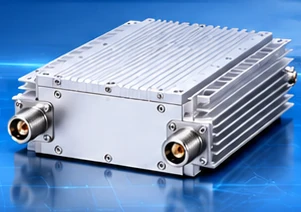
Reference 02 lists 1.2, 1.5 and 2.4 GHz, lower-band bandwidth 200 MHz (example 700–900 MHz), upper-band bandwidth 300 MHz (example 2–2.3 GHz), LDMOS, SMA → N, 556 g, 179.6 × 66.91 × 22 mm and a listed circulator; no features are listed. Reference 03 lists 3–4, 4–5, 5–6 and 3–6 GHz, 1 GHz and 3 GHz bandwidth labels, GaN, SMA → N and 203.5 × 90 × 24 mm; weight is not provided—confirm, and no features or circulator are listed.
Reference 10 lists 100 MHz–2.4 GHz, 300–400 MHz bandwidth, GaN, SMA → N, 425 g, 155 × 58 × 22 mm, thermal control and a VSWR function; no circulator is listed. Reference 16 lists 4–8 GHz, Revision 2, 4 GHz bandwidth, GaN and SMA → SMA; features are not provided—confirm, while weight and dimensions are conflicting records—confirm. Reference 17 lists 1–3 GHz, 2 GHz bandwidth, GaN, SMA → N, 977 g, 220 × 77 × 24 mm and no listed features or circulator. Reference 20 lists 2–7.2 GHz, 5.2 GHz bandwidth, GaN and 160 × 160 × 25 mm; connector is conflicting—confirm, weight is not provided—confirm, and no features or circulator are listed.
03 / 50 W references
How to read the documentation
The records use different kinds of evidence: discrete frequency points, ranges, example sub-bands, revision labels and bandwidth notation. A range should not be read as proof of uniform response across every point, and a bandwidth figure is not a substitute for a complete performance table. Reference 16’s Revision 2 label and reference 03’s review flags deserve document-level confirmation rather than silent normalization.
For civilian test or measurement work, request the applicable data sheet revision, mechanical drawing, connector definition and declared test conditions from the responsible supplier. Keysight’s RF measurement guidance explains that power results depend on sensor technology, calibration factors, uncertainty and traceability. Those measurement concepts are useful context, but they do not turn these catalogue labels into calibrated instrument specifications.
04 / 50 W references
Scope, compliance and next review
A component label does not certify an amplifier, a test setup or an end product. ILAC describes accreditation as an independent evaluation of conformity-assessment bodies for specific activities, including calibration and testing; the relevant question is therefore whether a named laboratory’s published scope covers the required activity. No certification, accredited result, availability, customer, factory or lead-time claim is made here.
The six records are comparison references for lawful civilian documentation review. They do not establish a supplied module for every supported band, and they do not infer a C-UAS, radar, interference or deployment role. Where a requirement falls outside a clearly documented record, treat it as a REQUESTED feasibility scope and seek written confirmation of the exact band, interface, revision, measurement basis and product status.