
TECHNICAL LIBRARY / 554
Drone Detection Microphone Array Supplier for OEM Product Integration
Choosing a drone detection microphone array supplier for original equipment manufacturer (OEM) product integration means buying a defined acoustic contribution to your product. New Ark presents project-scoped acoustic-core partnerships. Compare the proposed hardware, versioned software and documentation with the finished-product responsibilities your team will retain. [1]
ARTICLE SUMMARY
The purchasing decision
Evaluate a documented acoustic-core deliverable, not just an array name. Agree what arrives, what information it supplies and who owns the resulting product, changes and customer support.
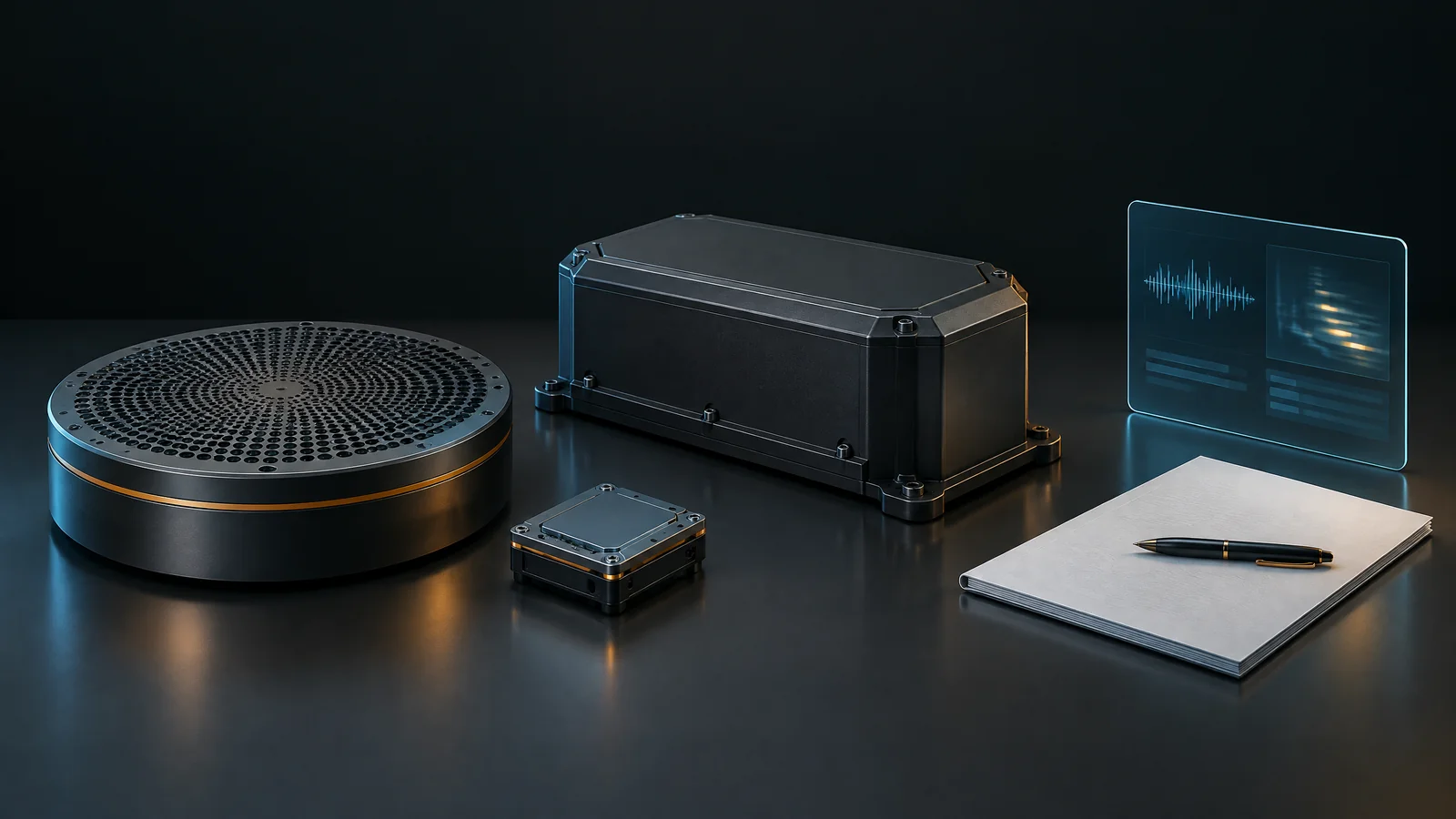
01 / DELIVERABLE REVIEW
1. Name the physical item being purchased
Printed circuit board assembly (PCBA) means a populated circuit board. A microphone array is a group of microphones used together; neither term describes the entire purchase.
Ask whether the proposal supplies a board, an array assembly or a finished assembly containing agreed hardware. Identify accompanying parts separately. A finished assembly can still be a subsystem for your equipment rather than a finished customer product.
New Ark's PCBA page treats the acoustic core as project-scoped. Translate that positioning into an itemized proposal so purchasing and engineering evaluate the same deliverable. The term module alone cannot establish what your team receives. [1]
02 / RELEASE REVIEW
2. Purchase a versioned release, not an unnamed capability
The hardware description should connect to an identifiable software release and matching documentation. These records establish the agreed product baseline for later integration decisions.
Request a release record naming the board revision, included software and applicable document editions. Distinguish supplied software from partner-developed software and third-party dependencies. This makes it possible to compare a received item with the proposal without assuming every release is interchangeable.
Include known limitations and unresolved integration questions in that record. Acceptance can then reference the agreed release and evidence rather than a demonstration of another version. Version identification is a purchasing requirement, not a request for public operating settings.
03 / INFORMATION REVIEW
3. Define what the acoustic information means
An information contract describes what the core supplies and what the receiving product may infer from it. It is more useful than an unexplained promise of compatibility.
Ask for a controlled description of the information categories, their meaning and any qualifications attached to them. Distinguish an acoustic observation from the partner's customer-facing alert or conclusion. The host product—the complete equipment incorporating the core—owns that downstream presentation.
Agree who maintains this description when output meaning changes. New Ark's programme identifies interfaces and acceptance basis as written-review topics. An interface document supports integration assessment; it does not establish that a particular receiving product has already been integrated. [1]
04 / PRODUCT REVIEW
4. Retain an identifiable finished-product owner
The partner's product definition includes its enclosure, software experience, customer claims and service offer. Buying the acoustic core does not settle those product decisions.
Name who approves the host product for release and who answers customers about it. A supplier can contribute subsystem expertise while the partner retains its brand and customer relationship. Record which product engineering and quality activities each party undertakes.
For EU product rules, the Blue Guide explains that an own-name or own-trademark manufacturer retains conformity responsibility even when work is subcontracted. The applicable legislation must be identified for the actual product; commercial role labels do not replace that assessment. [2]
05 / LICENSING REVIEW
5. Match software and documentation rights to your business
Hardware ownership is not a complete software licence. Confirm the permissions needed to incorporate the supplied technology into the partner's product and support that product.
WIPO, the World Intellectual Property Organization, recommends identifying licensed technology clearly, including relevant software versions and documentation needs. A defined licence subject is more useful than a broad reference to proprietary technology. [3]
Discuss permitted product use, subcontractor access, update rights and authorized sharing of documents. Address ownership and permitted use of jointly created work separately. These terms should match your commercial model; access to source code or continuing engineering assistance should not be inferred from board supply.
06 / EVIDENCE REVIEW
6. Separate acoustic-core evidence from host-product evidence
A component report answers questions about the component described in it. It does not automatically support the partner's finished-product claims or every later product revision.
Request the report's subject, revision and conclusions, with relevant limitations. Then identify which host-product claims need additional evidence. Keep supplier-reported results distinguishable from independent assessments so the product team knows the basis of each claim.
The EU Blue Guide allows integrated-product conformity assessment to contribute to complete-product documentation while retaining the complete manufacturer's responsibility. Components may also have their own obligations under specific legislation. Agree access to relevant evidence rather than treating a component document as blanket host approval. [2]
07 / CHANGE REVIEW
7. Assign responsibility when either product changes
Changes can originate with the acoustic supplier or the host-product team. A useful agreement names who reviews their effects on the integrated product.
For example, a partner's new enclosure or receiving-software release may affect the basis of earlier integration evidence. A supplier revision may alter the applicable documentation. Identify who issues change notices and who approves the revised host release.
Keep responsibilities specific: the supplier addresses its agreed core changes, while the partner coordinates review of its product. New Ark identifies change control as a written governance topic. Confirm the scope and cost of additional review instead of assuming every partner modification remains supported. [1]
08 / HANDOVER REVIEW
8. Handover a usable package and a support route
Handover should let the partner identify what it received and direct later questions to the correct owner. Documents are part of that usable deliverable.
Agree a document index covering the supplied-item description, release record, information contract, available evidence and known open issues. Assign responsibility for maintaining each item. Ask which records may accompany your customer documentation and which remain restricted to authorized reviewers.
Separate customer service from supplier support for the acoustic core. Confirm issue escalation, warranty boundaries, maintenance terms and end-of-support communication. New Ark's PCBA page provides a route to discuss these responsibilities; the project agreement establishes the actual documentation and service commitments. [1]
BUYER REVIEW CHECKLIST
Acoustic-core purchasing checklist
Identify the supplied board, array or finished assembly and its accompanying items.
Link hardware and software revisions to the applicable document editions.
Define information meaning and the owner of downstream customer presentation.
Name the host-product owner and the parties responsible for release evidence.
Agree software permissions, document access and rights to joint work.
Assign change notification, impact review and host-release approval responsibilities.
Specify handover records, customer support and contracted acoustic-core support separately.
SOURCE ATTRIBUTION
The evidence behind this discussion
Numbered references match the source markers in this article. Sources are named without outbound links. The review date records when references were reviewed, not when the source was published. Guidance and first-party descriptions do not establish New Ark product performance or site suitability.
[1] New Ark — Acoustic Detection PCBA & Array Integration · Reviewed 8 November 2026
First-party positioning describes a project-scoped acoustic core, partner product ownership and written documentation, change and support responsibilities; it does not establish a particular supply or service commitment.
[2] European Commission — Blue Guide 2022 · Reviewed 8 November 2026
Non-binding EU guidance explains component scope and complete-product manufacturer responsibilities, including documentation and subcontracted work; it is not a product-specific conformity determination.
[3] World Intellectual Property Organization — Successful Technology Licensing · Reviewed 8 November 2026
WIPO recommends clearly identifying licensed technology and separately addressing documentation, know-how and assistance needs; it does not establish rights in New Ark technology.
PUBLIC REFERENCE BOUNDARY
A clearer project discussion, not an operating instruction.
01The information roles described here depend on lawful purpose, environmental conditions and independent project evidence. No detection, coverage, identification, interoperability or safety outcome is guaranteed.
02Passive reception is not a hazardous-area certification. Qualified professionals must review equipment approval, site permissions, protected services and the written scope before any engineering decision.
03This article supplies no sensor layout, signal-processing method, threshold, target-selection method, RF-control procedure or operational response instruction. Data rights and decision authority remain with the responsible parties.
ARTICLE FAQ / 554
Questions on Drone Detection Microphone Array Supplier for OEM Product Integration
Answers address evidence, limitations and written project scope, not operational instructions.
RECORDACOUSTIC TECHNICAL LIBRARY
PROJECT DISCUSSION
Review the acoustic core for your OEM product
Explore New Ark's PCBA delivery approach, then share your product brief and desired deliverable. Use a partner discussion to clarify the release package, information contract, documentation access and responsibilities before requesting a scoped proposal.
Review the full ARC-PERIMETER perimeter solution.
A consolidated reference from microphone-array networking to layered perimeters and project validation.

Buying an Acoustic Core, Not a Black Box: PCBA and Local-Assembly Paths
Buying an acoustic core gives an equipment maker a different starting point from buying a finished system. A printed circuit board assembly (PCBA) can become a subsystem in your own product, but the enclosure, software permissions, acceptance evidence and customer obligations still need defined owners. The useful question is not how much of the supplier's technology you can see. It is whether you can explain what you are buying, what you may do with it, and who will resolve a problem after your product reaches a customer.
Audio Capture Is Not Recording Retention: Privacy Boundaries for Acoustic Detection
A microphone array captures sound; that does not establish whether a system stores recordings. For an acoustic drone-detection review, both facts matter, but neither settles the privacy question. The assessment concerns what information about people is processed, why it is needed and what happens to it throughout the service. An aircraft-detection purpose does not make incidental speech irrelevant, while the presence of a microphone does not make every sound personal data.