
TECHNICAL LIBRARY / 553
Drone Detection Microphone Array Supplier: Evaluating the Acoustic Core
Evaluating a drone detection microphone array supplier starts with identifying the item behind the quotation. Microphone components, an assembled array and an acoustic detection core are different purchases. The useful question is not simply whether microphones are included, but what documented capability arrives with them and what your team must still supply.
ARTICLE SUMMARY
The buying distinction
Evaluate the supplied layer, not the product label. Component documentation describes a component; recognition evidence must match the offered acoustic core. A finished-product commitment needs its own scope and lifecycle terms.
01 / SUPPLY BOUNDARY
1. Identify which of four layers you are buying
A drone detection microphone array supplier may quote an assembly without supplying the recognition capability implied by the application name.
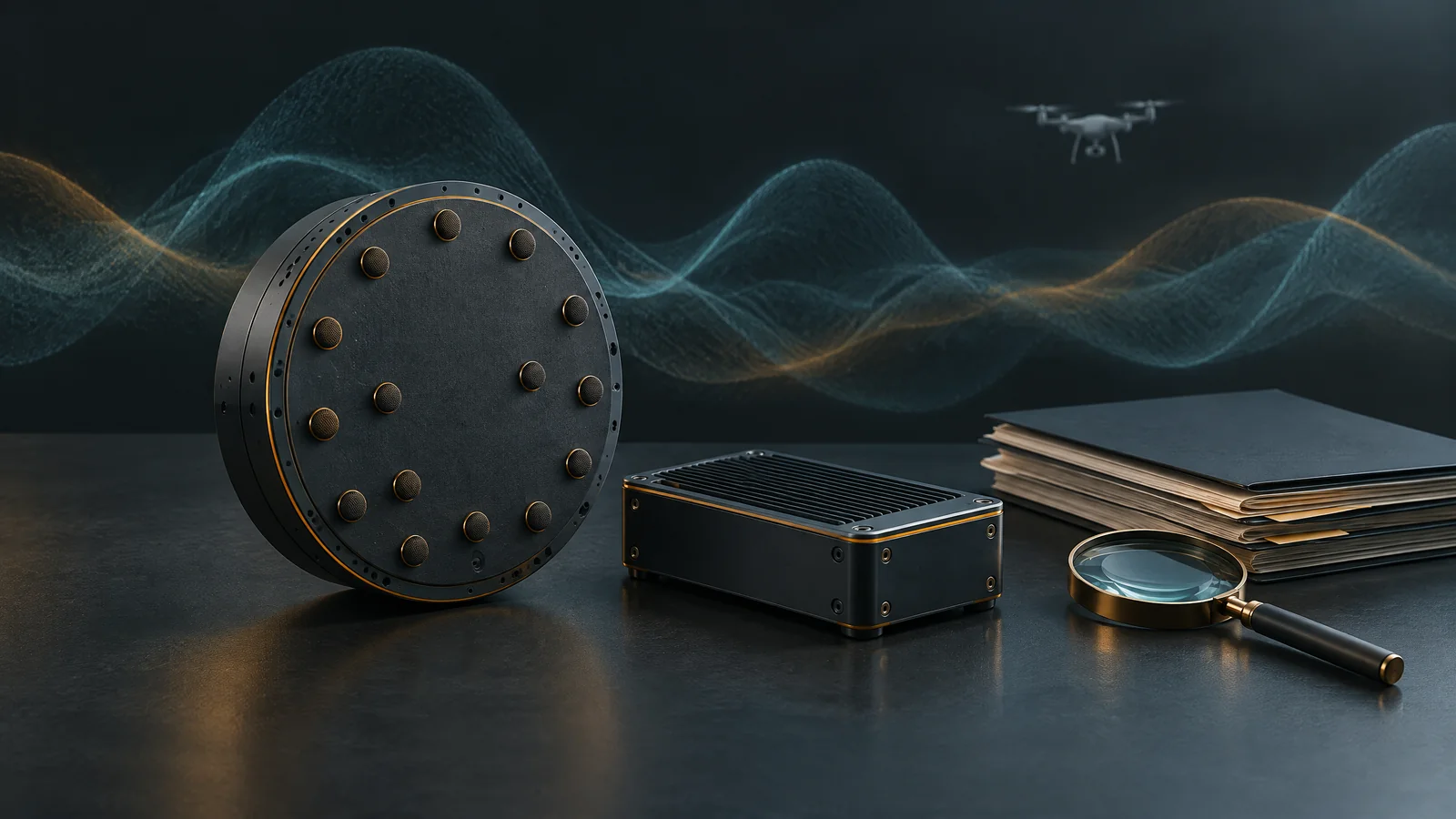
For purchasing, distinguish microphone capsules or elements from an array assembly that incorporates them. An acoustic core adds whatever detection functionality and associated software the contract specifies. A finished product adds the surrounding equipment and the defined customer-facing package. These are buying distinctions, not standardized supplier categories.
Ask the quotation to name its layer and exclusions. A board carrying microphones is not, by that fact alone, a drone detector. Conversely, an acoustic-core offer should explain its included functionality without suggesting that your enclosure, product documentation or customer support is already supplied.
02 / COMPONENT EVIDENCE
2. Read microphone literature at the component level
A manufacturer's datasheet can identify the microphone being purchased, but it cannot establish the recognition capability of the complete offer.
MEMS means microelectromechanical systems; a MEMS microphone is a component, not a complete detection product. TDK's component literature separately identifies microphones, evaluation hardware and versioned documents. That separation is useful: a development aid should not be mistaken for a production acoustic core. [2]
Request the proposed component identity and current document revision, or an authorized traceable summary where disclosure is restricted. Keep component evidence separate from assembly and detection evidence. A familiar microphone brand does not explain how the offered product distinguishes a drone-related sound from other sounds.
03 / DOCUMENT REGISTER
3. Make the supplied package identifiable
The deliverable description should let purchasing, engineering and quality teams recognize the same item without interpreting marketing language.
Ask for a document register linking the quoted item to its hardware revision, included software, licence terms and assembly identity. State whether microphones, enclosure, interface documentation and product-level records are included or supplied elsewhere. Each document should identify the item and version it covers.
A drone detection microphone array supplier should distinguish documents delivered with production units from reference material available only during evaluation. An offer can remain proprietary while still identifying its boundaries. If a drawing shows an enclosure but the quote supplies only a board, resolve that discrepancy before comparing prices.
04 / FUNCTION DESCRIPTION
4. Treat passive as a sensing description
Passive acoustic sensing listens for sound rather than transmitting a probing signal; the label does not describe every function of the purchased package.
It does not mean unpowered equipment, no network connections or no retained audio. Ask for a plain-language description of the complete package's functions and data handling. Evaluate those actual functions, rather than letting a passive label substitute for the product description or privacy review.
Passive also does not mean unaffected by surroundings. CISA identifies ambient noise and extreme weather as acoustic-sensing limitations. Its guidance recommends informed legal consultation before use of detection systems. Neither environmental suitability nor applicable obligations can be settled solely by the word passive. [1]
05 / RECOGNITION SCOPE
5. Separate sound capture from library-supported recognition
Microphones collect sound; a claim to recognize a drone type needs evidence about the offered recognition capability, not merely the microphone specification.
CISA states that accurate acoustic make/model identification relies on audio comparison libraries and asks manufacturers how often those libraries are updated. Ask which categories the offered version supports and how cases outside its documented scope are represented. A library's existence does not establish recognition of every aircraft. [1]
Clarify whether library access accompanies the hardware purchase and who controls subsequent releases. Distinguish a supported recognition category from an exact-model claim. You need a usable description of the evidence scope and update entitlement, not access to proprietary recordings or an explanation of the supplier's internal methods.
06 / CLAIM TRACEABILITY
6. Match evidence to the delivered acoustic core
Evidence becomes useful when the tested item and claimed function correspond to the hardware and software actually offered.
Keep three evidence levels distinct: component documentation, assembly records and acoustic-core evaluation. Ask whether a report concerns the quoted version, an earlier prototype or a different finished product. Results for one level do not automatically establish the next, especially when the buyer supplies part of the finished equipment.
Request a readable account of the evaluated claim, represented conditions, non-drone examples and material limitations. CISA recommends asking about false positives and previous testing. Separate independent findings from supplier-reported results; a demonstration of an alert is not equivalent to documented classification evidence. [1]
07 / INFORMATION MEANING
7. Understand what the sensor information means
An acoustic observation can inform equipment users without establishing an aircraft's authorization, the operator's identity or anyone's intent.
Ask the supplier to explain the meaning of each reported event in ordinary language. Does a label describe a possible acoustic match, a supported category or a more specific identification claim? The description should preserve uncertainty rather than turn every sound-related event into a confirmed threat.
Keep the promised information separate from judgments made by the buyer's wider security organization. A more detailed product display is not evidence of intent. Purchasing teams should know what information the core supplies and what interpretation remains outside it, without assuming that sensor data resolves every security question.
08 / PRODUCT CONTINUITY
8. Check whether the core fits your product lifecycle
A drone detection microphone array supplier needs to fit the buyer's production and support horizon, not just the initial evaluation purchase.
Ask about component-status notices, assembly revisions and software support together. TDK's portfolio includes product-specific end-of-life notices, illustrating why current documentation is not a promise of future supply. Establish who assesses substitutions, which evidence needs refreshing and how the buyer receives change notices. [3]
For New Ark discussions, keep the scope focused on the proposed acoustic core and printed circuit board assembly, or PCBA. Identify the deliverable and the product responsibilities your team retains. Availability, replacement support and any partner assembly work should become written project commitments, not assumed properties of a core.
BUYER REVIEW CHECKLIST
Eight checks before comparing acoustic-core quotations
Supply layer: Mark the offer as microphone components, array assembly, acoustic core or finished product; record excluded layers.
Identity: Link the quoted item to hardware revisions and current component documents or an authorized traceable summary.
Package: List included software, licence rights, enclosure and interface documentation, with responsibility for missing items.
Passive label: Request the package's function and data-handling description, including whether audio is retained.
Library: Record supported recognition categories, unsupported-case reporting and update entitlement. [1]
Evidence: Link each claim to the evaluated item and version; distinguish component, assembly and core evidence.
Output meaning: Define event labels and uncertainty without implying operator identity, authorization or intent.
Lifecycle: Confirm change notices, substitution responsibility, evidence refresh and hardware/software support periods.
SOURCE ATTRIBUTION
The evidence behind this discussion
Numbered references match the source markers in this article. Sources are named without outbound links. The review date records when references were reviewed, not when the source was published. Guidance and first-party descriptions do not establish New Ark product performance or site suitability.
[1] CISA — Unmanned Aircraft System Detection Technology Guidance for Critical Infrastructure · Reviewed 8 November 2026
Primary guidance supports acoustic-library, environmental-limitation, evaluation and maintenance questions. It does not validate a supplier's product, compatibility or performance.
[2] TDK — T5838 MEMS Microphone Product Documentation · Reviewed 8 November 2026
Primary component literature distinguishes microphone identity, evaluation hardware and versioned documentation. It is not evidence of drone recognition or a claim about New Ark's component sourcing.
[3] TDK — SmartSound MEMS Microphone Portfolio · Reviewed 8 November 2026
Product-specific lifecycle notices support checking component status and supply continuity. They do not describe every microphone product or any New Ark bill of materials.
PUBLIC REFERENCE BOUNDARY
A clearer project discussion, not an operating instruction.
01The information roles described here depend on lawful purpose, environmental conditions and independent project evidence. No detection, coverage, identification, interoperability or safety outcome is guaranteed.
02Passive reception is not a hazardous-area certification. Qualified professionals must review equipment approval, site permissions, protected services and the written scope before any engineering decision.
03This article supplies no sensor layout, signal-processing method, threshold, target-selection method, RF-control procedure or operational response instruction. Data rights and decision authority remain with the responsible parties.
ARTICLE FAQ / 553
Questions on Drone Detection Microphone Array Supplier: Evaluating the Acoustic Core
Answers address evidence, limitations and written project scope, not operational instructions.
RECORDACOUSTIC TECHNICAL LIBRARY
PROJECT DISCUSSION
Define the acoustic-core package with New Ark
Review acoustic-core and PCBA supply boundaries, then discuss the documents and lifecycle responsibilities your equipment project needs. Request a project-scoped response before treating any proposed package as a finished-product commitment.
Review the full ARC-PERIMETER perimeter solution.
A consolidated reference from microphone-array networking to layered perimeters and project validation.

Buying an Acoustic Core, Not a Black Box: PCBA and Local-Assembly Paths
Buying an acoustic core gives an equipment maker a different starting point from buying a finished system. A printed circuit board assembly (PCBA) can become a subsystem in your own product, but the enclosure, software permissions, acceptance evidence and customer obligations still need defined owners. The useful question is not how much of the supplier's technology you can see. It is whether you can explain what you are buying, what you may do with it, and who will resolve a problem after your product reaches a customer.
Audio Capture Is Not Recording Retention: Privacy Boundaries for Acoustic Detection
A microphone array captures sound; that does not establish whether a system stores recordings. For an acoustic drone-detection review, both facts matter, but neither settles the privacy question. The assessment concerns what information about people is processed, why it is needed and what happens to it throughout the service. An aircraft-detection purpose does not make incidental speech irrelevant, while the presence of a microphone does not make every sound personal data.