
TECHNICAL LIBRARY / 531
Airport Drone-Incident Safety: Aviation Authority and FOD
For airport engineering and operations teams, a drone incident raises separate questions: what the evidence establishes, who has authority, and whether a proposed capability introduces additional aviation hazards. These questions cannot be collapsed into a supplier's performance claim. Official FAA and ICAO publications support an approach that treats approvals, infrastructure compatibility and foreign object debris as distinct responsibilities, with accountable people retaining ownership of consequential decisions.
ARTICLE SUMMARY
Separate capability from permission
Airport counter-drone procurement needs more than evidence that equipment functions. The legal basis for its use, aviation review and effects on existing infrastructure require separate substantiation. The FAA's published agreement announcement is not a universal product endorsement, while ICAO's conflict-zone resolution is not an airport operating authorization. FOD guidance adds another distinction: an airborne concern and a debris hazard are related safety questions, but evidence of one does not establish the other.
Authority
Detection does not confer intervention authority
FAA airport guidance (2025) distinguishes drone detection from mitigation and expressly states that detection systems cannot determine intent or threat level. A useful procurement distinction follows: ownership of equipment is not evidence of permission to exercise every capability it contains. Engineering acceptance and statutory authority address different questions. The same guidance identifies regulatory and grant-assurance considerations and requires an approved drone response plan within the certification manual for Part 139 airports. That approval requirement should not be mistaken for authorization of a particular counter-drone technology.
Federal assessment
What the FAA–DOW announcement actually establishes
The FAA–DOW safety agreement announcement (2026), published April 10, confirms a joint safety assessment of a high-energy laser counter-drone system and continued interagency coordination. Its public text does not supply the underlying assessment, technical annexes or a commercial certification. Airport buyers therefore cannot transfer its findings to unrelated equipment or settings. The relevant lesson is the existence of a defined assessment and accountable coordination, not a general endorsement. The announcement establishes neither blanket airport permission nor a blanket prohibition on lighting or lasers.
International scope
Read ICAO A42-4 within its conflict-zone remit
ICAO's provisional publication of Resolution A42-4 (2025) is titled Addressing risks to civil aviation arising from conflict zones. It reaffirms the principle against using weapons against civil aircraft in flight and emphasizes State responsibilities, information sharing and civil-military cooperation. Its scope matters: it is not a certification standard for airport counter-drone products or a local authorization instrument. Its governance relevance is protecting civil aviation when security activity creates additional risks. Applying that principle does not justify presenting a conflict-zone resolution as an airport-specific technical approval.
Debris risk
FOD is a hazard category, not proof of damage
FAA FOD guidance (2024) defines foreign object debris through inappropriate location and the capacity to injure personnel or damage aircraft. It separately defines damage attributed to a foreign object. This distinction prevents an airport report from treating suspected debris as confirmed aircraft damage. Drone fragments could fall within the debris concept, but their presence or consequences require evidence. A counter-drone proposal that discusses only the airborne concern leaves a material safety question unanswered: how potential debris affects the airport's existing responsibilities for people, aircraft and infrastructure.
Infrastructure
Include the hazards a security system may introduce
FAA airport guidance (2025) highlights potential electromagnetic interference with aviation communications and navigation equipment, alongside disruptive second-order effects on airport operations. Infrastructure compatibility is therefore part of the safety argument, not an accessory feature. Procurement documentation should distinguish what has been examined from what remains unevaluated, including effects on existing services and the scope of aviation review. A successful demonstration of the security function does not establish compatibility with airport infrastructure. Suppliers' broad assurances are weaker evidence than documented findings tied to the actual proposed system.
Accountability
Make evidence ownership visible in the contract
The procurement record should connect each compliance claim to its issuing authority, applicable document and named owner. Test reports need a clear scope and stated limitations; an approval needs its actual conditions rather than a marketing paraphrase. Incident records should separate observations from interpretations and preserve unresolved uncertainty. This is a human-accountability issue: software output and vendor statements do not absorb the airport's responsibilities. Where evidence is incomplete, the defensible conclusion is that a claim remains unproven, not that urgency makes it reliable or that absent evidence disproves it.
SOURCE ATTRIBUTION
The evidence behind this discussion
Sources are named here without outbound links. Research findings and reported events do not establish New Ark product performance or site suitability.
FAA, UAS Detection, Mitigation, and Response on Airports · 2025-06-23
Distinguishes detection from mitigation, states that detection cannot determine intent or threat level, and discusses aviation coordination, infrastructure interference, compliance and approved airport response-plan requirements.
FAA, FAA and DOW Sign Landmark Safety Agreement to Protect Southern Border · 2026-04-10
Announces a joint assessment of a high-energy laser counter-drone system and continued coordination; the public release does not reproduce the assessment or provide a commercial product certificate.
ICAO, Resolution A42-4 in Resolutions Adopted by the Assembly, Provisional Edition · 2025-10
Addresses conflict-zone risks to civil aviation, reaffirms the principle against weapons use against civil aircraft in flight, and emphasizes State responsibilities, information sharing and civil-military cooperation.
FAA, AC 150/5210-24A, Airport Foreign Object Debris Management · 2024-02-08
Defines foreign object debris separately from foreign object damage and explains the circular's advisory status and mandatory applicability for specified funded projects.
PUBLIC REFERENCE BOUNDARY
A clearer project discussion, not an operating instruction.
01The information roles described here depend on lawful purpose, environmental conditions and independent project evidence. No detection, coverage, identification, interoperability or safety outcome is guaranteed.
02Passive reception is not a hazardous-area certification. Qualified professionals must review equipment approval, site permissions, protected services and the written scope before any engineering decision.
03This article supplies no sensor layout, signal-processing method, threshold, target-selection method, RF-control procedure or operational response instruction. Data rights and decision authority remain with the responsible parties.
ARTICLE FAQ / 531
Questions on Airport Drone-Incident Safety: Aviation Authority and FOD
Answers address evidence, limitations and written project scope, not operational instructions.
RECORDACOUSTIC TECHNICAL LIBRARY
PROJECT DISCUSSION
Take the evidence questions into a written project scope.
Explore the PCBA delivery references or discuss your procurement, compliance and information-rights questions with New Ark. Available documents are project references, not a performance or certification commitment.
Review the full ARC-PERIMETER perimeter solution.
A consolidated reference from microphone-array networking to layered perimeters and project validation.
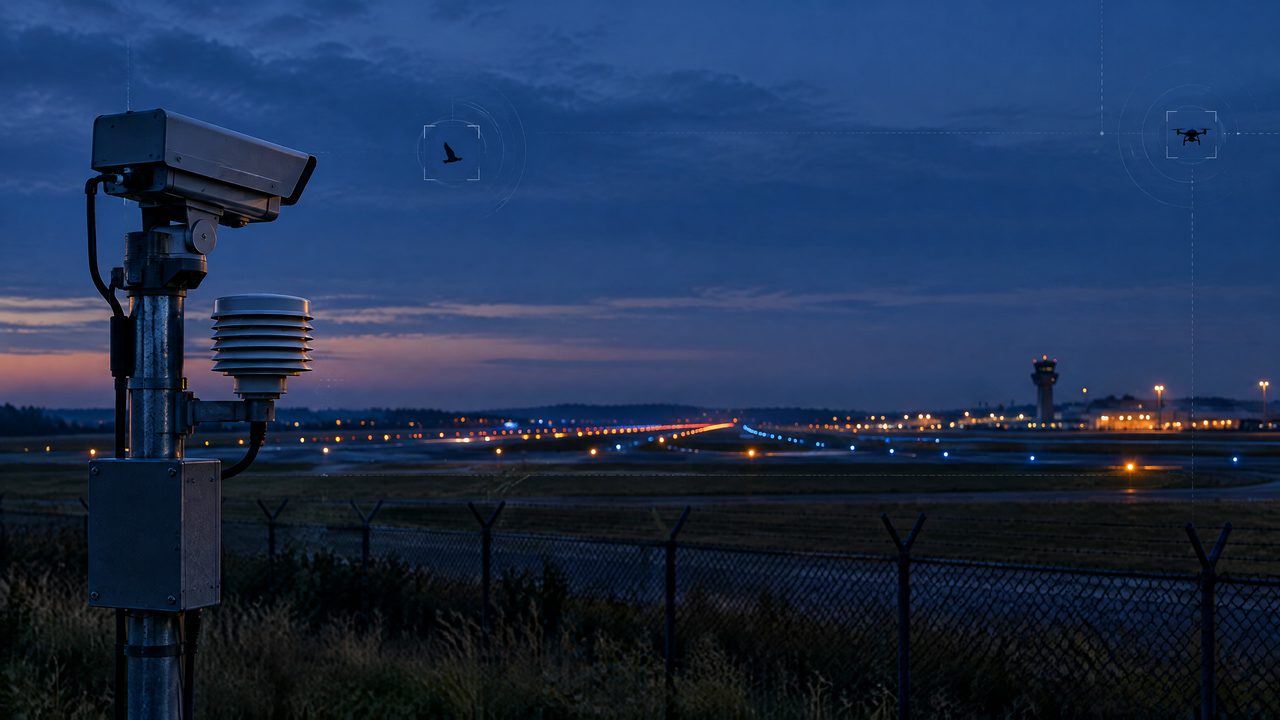
How Multi-Sensor Integration Improves Airport Drone Detection
For this educational guide, improvement means a more understandable and accountable information review—not a promised increase in detection performance. Airports may consider separate acoustic, RF, radar and electro-optical or infrared information roles where authorised and relevant. The focus is on aviation continuity, evidence limits and human responsibility, without prescribing a sensor combination or an operational response.
Why Airports Need Passive Acoustic Drone Detection Systems
An educational, governance-first guide to discussing the conditional role of passive acoustic information in airport continuity planning. It treats acoustic, RF-related, radar, EO/IR and C2 information as distinct, bounded evidence roles for authorised human review and documented validation—not as a deployment design, response procedure, product comparison or promise of detection, safety, availability or operational outcome.