
COMPANY NEWS / RELEASE 11
Acoustic vs. RF drone detection:
why fusion supports industrial-perimeter assessment.
Low-altitude targets do not present the same signals or environmental characteristics. For high-hazard industrial sites—including refineries, LNG terminals, chemical parks, and energy storage—project teams commonly assess passive acoustics and RF reception as complementary information inputs, alongside safe-offset siting, optical corroboration, authority controls, and written validation.
TECHNICAL SUMMARY
Acoustics and RF are not substitutes; they are different information inputs under different conditions.
Passive acoustics can collect rotor-, propulsion-, and ambient-related sound information through distributed microphone arrays without using active RF transmission to obtain that information. RF reception can provide a different project-level input where observable wireless signals are present. Both are affected by site conditions, background environment, mounting, target characteristics, interfaces, regulation, and validation. Identification, location assessment, alert escalation, and any subsequent arrangement remain subject to accountable people and written project scope.
+ RFSAFE OFFSET · CORROBORATION · GOVERNANCE
REVIEWED PROJECT SCHEMATIC / 00
Industrial perimeter information architecture.
The schematic places perimeter passive-acoustic, RF-reception, and other authorised information inputs in an external safe buffer, organised through project-level corroboration, accountable human roles, and written validation. It does not depict equipment placement inside a core process hazard area and is not an operating drawing or final engineering design.
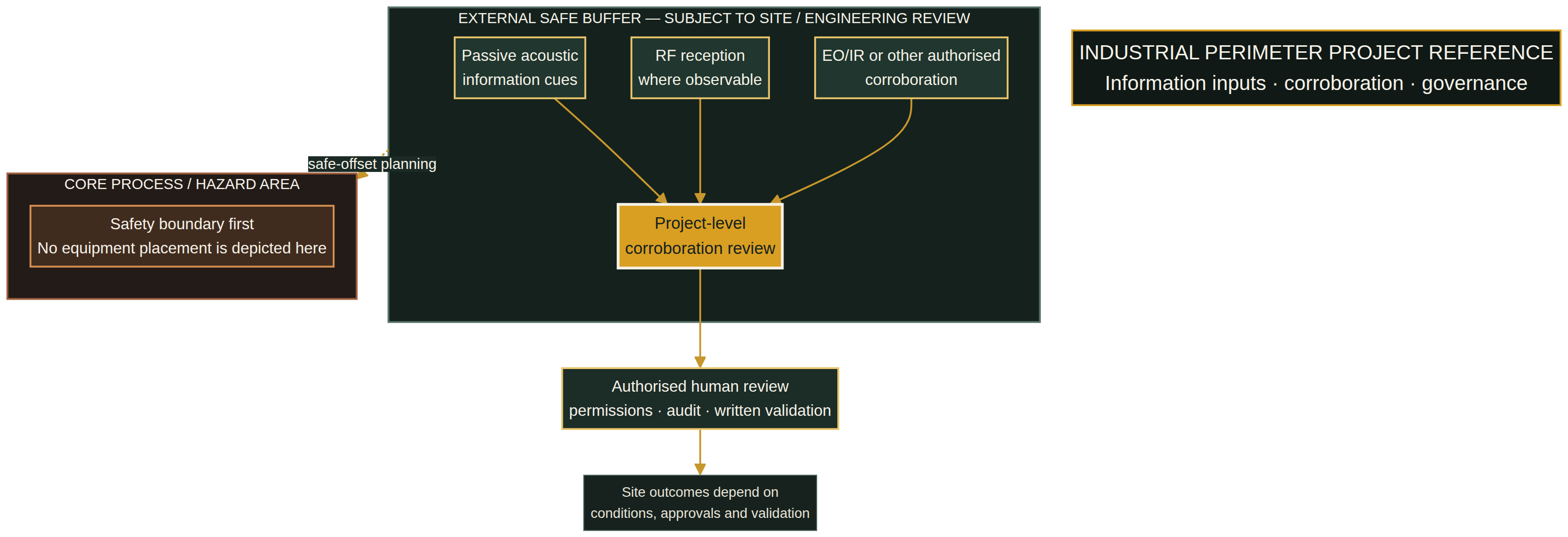
Project reference schematic · All node locations, data interfaces, equipment certification, and field outcomes remain subject to site engineering review and written validation.
COMPLEMENTARY INPUTS / 01
The two sensing paths have different site fit and different project limitations.
Keep capability discussion within site conditions, data responsibility, and verifiable boundaries.
Passive acoustic information
Microphone arrays may collect sound-source-related information as a complementary input for low-altitude event assessment without relying on a target’s wireless link. Ambient noise, wind, terrain, buildings, and node layout affect data quality.
RF reception information
Where observable remote-control, video-link, or telemetry signals are present, a project may assess RF reception as another information source. Observability, protection of legitimate services, and interface rules require site confirmation.
EO/IR and other corroboration
EO/IR, radar, fibre sensing, or other authorised sources can participate in cross-corroboration where data responsibility and site authority are defined. This public page does not prescribe a fixed sensor combination.
Project-level event assessment
Cues from different sources can be organised through a project platform under defined permissions, alert rules, and audit requirements for authorised personnel to assess. They are not automatic conclusions outside the environment.
WHY FUSION / 02
Fusion does not remove limitations; it enables review of agreement and gaps across different information sources.
Different RF observability
Automated, pre-programmed, or fibre-guided contexts can have limited RF observability. Passive acoustics may contribute another input, but sound alone cannot confirm a target’s identity, source, or intent.
Industrial background noise
High-noise operations, wind, and complex reflections can affect acoustic information. RF reception, EO/IR, or other authorised sources may support project-level corroboration; they are not unconditional accuracy claims.
Reducing uncertainty
Agreement across sources can help teams review event priority, data quality, and the need for further corroboration. Any reduction in false alerts or improvement in availability must be established through site design, a validation plan, and written results.
Safe offsets and governance
High-hazard sites should first discuss hazardous areas, external safe buffers, equipment certification, and assessable mounting locations. Governed interfaces or subsequent arrangements require permissions, EMC review, site authority, and accountable people.
ARC-PERIMETER PROJECT REFERENCE / 03
Structure fusion discussion around perimeter information, corroboration, and human governance.
ARC-PERIMETER™ provides an architecture discussion frame for project teams—not a public operating method or delivery-outcome commitment.
Perimeter acoustic cueing
At assessed external safe-buffer locations, distributed acoustic nodes may provide an initial information layer. Node siting, power, networking, certification, and maintenance conditions remain subject to project review.
RF reception and association
Subject to applicable rules and site conditions, RF reception information may be reviewed in association with acoustic cues by time, area, or event context. Specific data handling and interfaces are defined in writing.
Multi-source corroboration
A project may discuss EO/IR, radar, fibre sensing, or existing-platform information for governed cross-corroboration. Sensor selection depends on site, environment, responsibility, and permission conditions.
Command, authority, and records
A project platform can organise tiered alerts, role permissions, retained records, and review. Any subsequent response is decided by authorised people under applicable permissions and written procedures.
COMPLIANCE & PROJECT BOUNDARY / 04
A fusion architecture protects industrial safety, public communications, and aviation constraints before capability discussion.
01Acoustic and RF reception are project-level information inputs. Background conditions, targets, mounting, interfaces, environment, and regulation affect assessment; this page does not promise detection, classification, location assessment, tracking, availability, or safety outcomes.
02Passive acoustics does not use active RF transmission to acquire acoustic information. Power, communications, networking, equipment certification, EMC, and industrial interfaces for any system still require confirmation against the site, standards, and engineering review.
03Any arrangement involving governed equipment, spectrum use, aviation-safety interfaces, or subsequent response must meet competent-authority permission, site authority, accountable human roles, and written project scope. This public release provides no operations, target selection, signal control, or response procedure.
NEWS FAQ / 11
Frequently asked questions on acoustic and RF fusion for industrial-perimeter assessment.
These answers align with the technical explainer and support project discussion, not equipment operation, performance commitments, or a governed response procedure.
RECORDRELEASE 11 / FUSION PROJECT FAQ
NEXT REFERENCE
CONTENT DISTRIBUTION / SHARE
Share this reviewed project release.
Opens the platform share interface in a new window.
Review the full ARC-PERIMETER perimeter solution.
A consolidated reference from microphone-array networking to layered perimeters and project validation.

Acoustic Drone Detection vs. RF Detection: Why Critical Infrastructure Needs Multiple Sensors
A governance-first comparison of passive acoustic and RF information roles for airports, energy facilities, ports, data centres and other critical infrastructure. It explains conditional evidence, protected services, accountable review, lawful authority, integration and written validation—not a sensor prescription, placement plan, threshold, signal-control method or performance claim.
Drone Detection for Critical Infrastructure: A Project Guide for Airports, Energy Facilities and Data Centers
A governance-first guide to discussing acoustic, RF, radar, EO/IR and visual information for airports, energy facilities, ports and data centres. It frames protected services, conditional evidence, interfaces and written validation—not a sensor prescription, deployment plan, threshold, control method or performance claim.